
Commercial Display Fabrication That Performs

A display can look exceptional on the workshop bench and still fail where it matters: under retail lighting, in frequent customer contact, during transport, or after months on a busy counter. Commercial display fabrication is the discipline of preventing that gap between visual intent and real-world performance. It brings material selection, structural design, precision cutting, forming, assembly and finishing into one controlled manufacturing process.
For retail brands, shopfitters, designers and project managers, the objective is not simply to produce a display. It is to produce a component or installation that presents the brand correctly, fits the site, withstands its intended use and can be reproduced consistently when the project expands.
What commercial display fabrication needs to achieve
Commercial displays are expected to do several jobs at once. They must attract attention, support products or information, work within a defined footprint and maintain a refined finish in an environment where people will see and touch them closely. A minor inconsistency in an edge, joint or printed panel can be far more visible than it would be in a general industrial component.
That is why fabrication should begin with the operating conditions, not just a visual reference. Is the display freestanding, wall-mounted, counter-mounted or integrated into a larger fit-out? Will it carry merchandise, support digital equipment or act mainly as branded signage? Is it a short-term campaign unit, or a permanent fixture expected to remain presentable for years?
These answers determine the appropriate material thickness, jointing method, support structure and finish. They also influence practical matters such as pack-down, installation access and replacement parts. A highly polished acrylic plinth may suit a protected showroom, for example, but a high-traffic retail floor may require a more forgiving finish, concealed reinforcement or a design that allows damaged panels to be changed without replacing the entire unit.
Material selection is a performance decision
Acrylic is widely used in commercial displays because it offers clarity, colour options, clean machined edges and substantial design flexibility. It can be laser cut, CNC cut, folded, thermoformed, welded and finished to create forms that are difficult to achieve with many other materials. Yet acrylic is not a single, interchangeable choice.
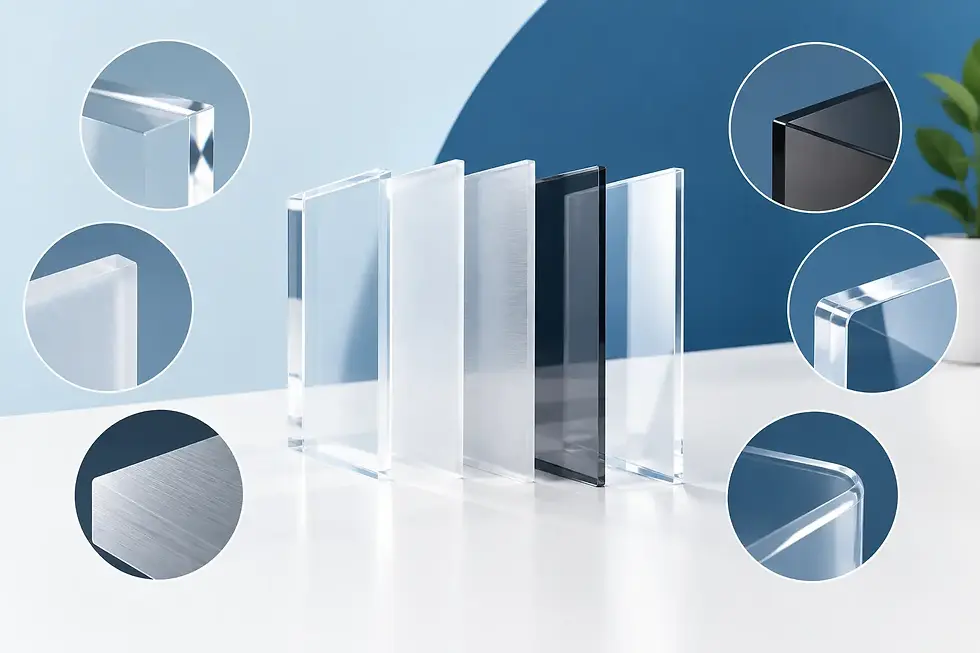
Cast and extruded acrylic behave differently during machining, polishing and thermoforming. Clear acrylic may be the right choice when product visibility is the priority, while coloured, frosted or opal material can control light transmission, conceal fixings or reinforce a brand palette. Mirror acrylic creates impact with less weight than glass, but requires careful handling and suitable detailing to avoid visual distortion or surface damage.
Thickness also needs proper consideration. Selecting a thicker sheet simply to make a display feel stronger can increase weight, alter the appearance of edges and complicate forming. Conversely, a visually light design may need discreet bracing, internal returns or engineered fixing points rather than a thicker face panel. The best result is usually achieved by matching the material and construction to the load path, site conditions and desired visual effect.
For projects combining acrylic with timber, metal, LEDs, printed graphics or digital screens, tolerances become even more critical. Each material expands, fixes and finishes differently. The fabrication process must account for those interactions before production begins, rather than asking installers to resolve them on site.
Commercial display fabrication starts before cutting
The most expensive display problems are often created at the approval stage. A drawing may communicate the overall concept well, while leaving unanswered questions about panel orientation, visible edges, fixing access, LED serviceability or the tolerance between fabricated parts and site-built elements.
Technical consultation converts a concept into a manufacturable specification. This process tests the details that affect cost, quality and repeatability: sheet sizes, nesting efficiency, bend radii, engraving depth, adhesive joints, hardware locations and assembly sequence. It can also identify where a minor design adjustment will improve strength or reduce labour without compromising the visual outcome.
Prototyping is particularly valuable where the display introduces a new format, unusual material combination or customer interaction. A physical prototype reveals things that screen renders cannot: whether a shelf flexes under load, whether a folded panel remains square, whether reflected light obscures graphics, or whether the product can be placed and removed easily.
Not every project requires a full prototype. For a repeat product line with established drawings and proven construction, a first article or sample component may be sufficient. For a flagship activation or multi-site rollout, investing in design validation early can protect the entire production schedule.
Precision cutting, forming and assembly define the finish
Commercial display fabrication relies on a sequence of specialised processes, each selected for a reason. Laser cutting can produce intricate profiles, internal cut-outs and engraved details with fine visual definition. CNC cutting is suited to accurate shapes, rebates, pockets and repeated components where dimensional control is central to the assembly.
Acrylic folding creates crisp, controlled angles for trays, risers, brochure holders and housings. Thermoforming allows more complex contours, but requires careful tooling and process control to manage material movement and maintain consistent wall thickness. Acrylic welding and adhesive bonding can create clean, durable joints when surfaces are prepared accurately and the assembly is correctly aligned.
The fabrication method affects the display's appearance as much as its strength. A flame-polished edge may provide a bright, clear result in the right application, while a machined or hand-finished edge may better suit a particular aesthetic or component geometry. Visible joints need to be considered from the earliest design stage. If a join cannot be hidden, it should be intentional, consistent and appropriate to the display's level of finish.
This is where capable fabrication is distinct from basic cut-to-size supply. The work is not merely producing individual acrylic panels. It is controlling how those panels relate to one another, how they are handled through production, and how the completed display will present once installed.
Designing for transport, installation and maintenance
A display that is difficult to move or assemble can consume time and budget after it leaves the factory. Large acrylic components are particularly vulnerable to scratching, cracking or distortion if they are poorly packed or forced through restricted site access. Modular construction can reduce this risk, but it adds interfaces that must align cleanly in the finished installation.
A practical design considers the complete journey from fabrication to site. It identifies which pieces should be pre-assembled, where protective film should remain in place, how hardware will be accessed and whether the display can be safely carried through doors, lifts and retail back-of-house areas. For interstate or multi-site deployment, packaging and labelling need the same discipline as the fabricated parts themselves.
Maintenance deserves equal attention. Displays located near point-of-sale areas, food service counters or public entry points may be cleaned frequently. Finishes and graphics should suit the cleaning regime, while high-contact areas may need material choices that minimise visible wear. If a light source, printed graphic or damaged panel may need replacement, the design should allow that work to occur without dismantling the entire fixture.
Consistency matters in repeat production
One-off displays give designers room for bespoke detailing. Production runs place greater emphasis on repeatability. The tenth unit must match the first in dimensions, clarity, colour, finish and assembly quality, even when the order is produced in stages or expanded over time.
This requires controlled drawings, documented material specifications, reliable tooling and disciplined quality checks. It also requires clear communication when a material batch, hardware item or production method changes. Small uncontrolled variations can become obvious across a national rollout, especially when multiple displays are installed side by side.
At Platinum Manufacturing, this control comes from treating design support, precision cutting, fabrication, finishing and delivery as connected stages rather than separate transactions. That approach helps clients make sound decisions early and maintain the required standard through bespoke work and larger production runs alike.
Choosing a fabrication partner for the project
The right supplier should be able to discuss more than sheet size and lead time. They should ask how the display will be used, what it connects to, what finish is expected and where risk sits in the programme. A supplier that identifies constraints early is often protecting both the design and the budget.
Experience with acrylic is especially relevant when the brief includes polished edges, formed components, illuminated elements, clear bonded assemblies or close-tolerance interfaces. These details cannot be treated as afterthoughts. They require the right equipment, practical judgement and quality control throughout manufacture.
The strongest commercial displays make their construction feel effortless because the engineering has been resolved before the public sees them. When material, process and purpose are aligned, the finished piece does more than hold products or carry a logo. It gives customers a clear, lasting impression of the brand behind it.


Comments