
Best Acrylic Edge Finishing Methods for Commercial Work

Acrylic can be cut to the correct shape and still fall short of the required standard at the edge. For commercial displays, branded signage, machine guards and architectural components, the best acrylic edge finishing methods are determined by more than appearance. Material grade, cut method, edge visibility, structural loading and production volume all affect the right choice.
A polished edge can make clear acrylic appear almost invisible in a premium retail installation. On the other hand, a crisp machined edge may be the better technical result for a bonded assembly or a component with tight tolerances. The goal is not to apply the glossiest finish to every job. It is to specify a finish that supports the design intent, performs reliably and remains consistent across every part.
Why acrylic edge finishing needs to be specified early
The edge finish begins with the material and cutting process, not the final polishing stage. Cast acrylic generally machines and polishes very well, which makes it a strong choice where optical clarity and premium presentation matter. Extruded acrylic can be cost-effective and suitable for many applications, but it may respond differently to machining, heat and solvent bonding.
Cut quality also determines how much finishing is needed. Laser cutting can produce a glossy edge on suitable clear acrylic, while CNC routing provides accurate profiles, internal cut-outs and controlled edge preparation. Neither process is automatically better. A laser-cut edge may be ideal for flat signage panels, while a CNC-machined edge is often more appropriate where dimensions, square edges or mechanical fit are critical.
This is why edge requirements should be discussed during design development. If a panel will be viewed from the side, illuminated along its edge, solvent welded or repeatedly handled by the public, the finishing process must be planned around that use. Leaving the decision until parts are already cut can add unnecessary cost or limit the achievable result.
Best acrylic edge finishing methods and where they fit
Laser-cut polished edges
A properly calibrated laser can leave a smooth, glossy edge directly from the cutting bed. This is one of the most efficient finishes for clear acrylic signs, display panels, point-of-sale components and decorative pieces with clean two-dimensional profiles. It can reduce secondary finishing and provide a highly presentable edge for many applications.
However, laser cutting is heat-based. On thicker material, certain colours, or parts requiring a perfectly square edge for bonding, the heat-affected edge may not be the best outcome. Laser-cut edges can also show minor stress sensitivity in applications involving aggressive solvents or later thermoforming. It is an excellent production method when matched to the material and end use, rather than treated as a universal answer.
CNC-machined and diamond-polished edges
For highly visible edges on premium acrylic work, diamond polishing is often the benchmark. The process uses a precision cutting tool to shave a fine layer from a machined edge, producing exceptional clarity and a straight, polished finish. It is particularly effective on thicker clear acrylic used in retail fixtures, museum displays, architectural elements and high-end fabricated units.
The main advantage is control. A CNC process can establish the profile and tolerance, then diamond polishing can create an optical finish without relying on heat. This supports consistent results across repeat production runs and helps retain the sharp geometry required for accurate fabrication.
Diamond polishing does require a suitable edge and adequate access for the equipment. Tight internal radii, complex contours and very small features may need a different finishing approach. It is also a specialised secondary operation, so it should be allowed for in both programme design and production planning.
Mechanical sanding and buff polishing
Mechanical sanding progressively refines a machined edge before buff polishing restores clarity. It is a versatile approach for shapes that cannot be diamond polished easily, including curves, radiused details, complex routed profiles and selected thermoformed components. With the correct sequence of abrasives and controlled buffing, it can produce a very high-quality finish.
This method relies heavily on operator skill and process discipline. Excessive heat during buffing can soften the acrylic surface, round a detail or introduce stress. It is therefore less efficient than diamond polishing for long, straight runs, but highly valuable where geometry demands a more hands-on finishing process.
For bespoke projects, mechanical polishing can provide the flexibility needed to finish details that are visually important but difficult to access with automated methods. The result should be assessed under the same lighting conditions expected in service, especially for transparent components placed beside illuminated graphics or reflective surfaces.
Flame polishing
Flame polishing uses a controlled flame to briefly soften the acrylic surface and create a glossy edge. It can be quick and visually effective on selected edges, particularly on parts with complex contours where other polishing tools cannot reach easily.
The trade-off is that flame polishing is heat-intensive and requires careful control. It can alter edge geometry, create localised stress or produce variations that are unsuitable for precision bonding and close-tolerance assemblies. It is generally best reserved for appropriate decorative or low-load applications, not treated as the default finish for every clear acrylic component.
When a project needs flame polishing, the edge should first be machined cleanly. Flame will not correct a rough routed edge or hide poor cut quality. It enhances a prepared surface; it does not replace preparation.
Fine-machined or satin edges
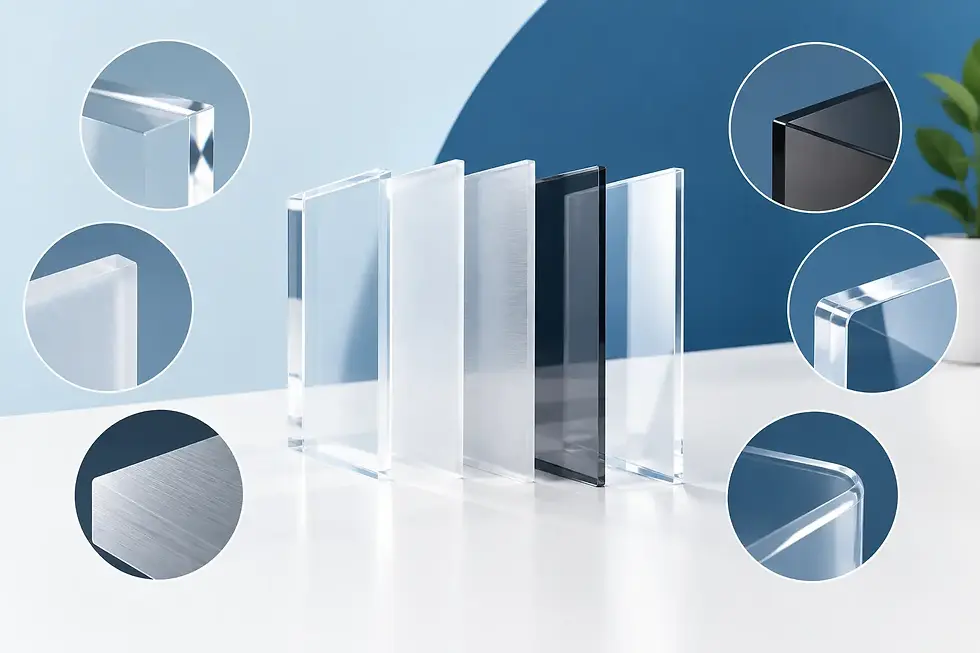
Not every project needs a clear polished perimeter. A finely machined edge can provide a precise, understated result, particularly for opaque, coloured, frosted or printed acrylic. On functional components, machine guards, protective panels and internal parts, a clean CNC edge may offer the best balance of cost, accuracy and performance.
A satin or deliberately frosted edge can also be a design choice. It diffuses light, reduces fingerprints and can complement a matte or textured face. For edge-lit acrylic, however, a frosted edge will scatter light rather than carry it cleanly. The finish must support the lighting strategy, not work against it.
Matching the finish to the application
For a customer-facing retail plinth or display case, clarity and uniformity are usually the priority. Diamond-polished straight edges, together with carefully finished corners and joints, are often worth the additional production time. The edge becomes part of the presentation, especially where products are lit from multiple angles.
For acrylic lettering, flat branded panels or repeated sign components, laser-cut edges may provide the most efficient and visually effective solution. Material thickness, colour and mounting method should still be confirmed before production, particularly if the parts are to be bonded, folded or exposed to significant sunlight.
For fabricated enclosures, guards and technical assemblies, dimensional accuracy may take precedence over high gloss. A precision-machined edge can ensure a dependable fit, while selected visible edges can receive secondary polishing where required. This approach avoids paying for cosmetic finishing where it adds no functional or visual value.
For large-format architectural or shopfitting elements, consider transport, handling and installation as well as finish. A perfectly polished edge can still chip if an exposed panel is poorly protected during site works. Edge treatment, corner radii, packing and fixing details should be considered as one system.
Edge finishing affects bonding and fabrication
Acrylic welding and solvent bonding require clean, compatible edge preparation. Highly polished surfaces are not always the ideal starting point for a structural bond, as the bonding process may need a controlled machined surface to achieve the correct joint quality. The appropriate sequence depends on the joint design, adhesive system and whether the bond will be visible.
This is particularly relevant for display boxes, aquariums, protective covers and fabricated units where clarity at the joint is as important as strength. A fabrication partner should assess the cut edge, material type, joint geometry and load path before committing to a finishing specification.
Thermoforming creates another consideration. If a part will be heated and formed after cutting, final edge finishing may be better completed after forming. Finishing too early can introduce handling damage or waste time on areas that will be trimmed away. Production order matters as much as the chosen method.
A practical specification for consistent results
Rather than describing edges simply as “polished”, define what the project needs. State whether edges are visible, whether optical clarity is required, which faces will be viewed, whether parts will be bonded, and whether the finish must match a sample or previous production run. For larger programmes, an approved first article is the most reliable reference point.
It is also useful to identify which edges are cosmetic and which are functional. A display panel may have two show edges that need a premium polish, concealed edges that only require a clean machine finish, and bond edges that need specific preparation. This targeted approach protects the budget without compromising the finished result.
At Platinum Manufacturing, edge finishing is considered alongside cutting, fabrication and final use, so the process supports the whole component rather than just its appearance. The strongest outcome comes from resolving these details before production begins, when material, finish and fabrication sequence can still be aligned.
A clear edge requirement gives manufacturers the information needed to produce consistently, and gives project teams fewer surprises when the finished acrylic arrives on site.


Comments