
CNC Routing Benefits for Precision Acrylic Work

A display panel can look straightforward on a drawing, yet become difficult to manufacture when it includes tight radii, flush-mounted fittings, cut-outs, engraved details and a finish that must hold up in a commercial setting. This is where CNC routing benefits become clear. For acrylic fabrication, CNC routing provides controlled, repeatable cutting that supports design intent from prototype through to production.
For project managers, designers and commercial buyers, the value is not simply that a machine can cut a shape. It is the ability to produce components with dependable dimensions, consistent edge quality and reliable fit across a single bespoke piece or hundreds of repeat parts. When paired with sound material selection, considered design and skilled finishing, CNC routing becomes a practical manufacturing tool for complex acrylic work.
CNC routing benefits for commercial acrylic projects
CNC routing uses computer-controlled movement to guide a cutting tool along an exact programmed path. Unlike manually marked and cut components, every feature is referenced to the same digital file. Holes, pockets, contours, rebates and engraved details can be positioned accurately relative to one another.
That control matters when a fabricated part must align with metalwork, timber joinery, lighting, printed graphics or existing site conditions. A small discrepancy in a mounting-hole pattern or locating edge can delay installation, create visible gaps or force costly on-site modification. CNC-routed acrylic components are made to the approved geometry, helping teams manage those interfaces before materials reach site.
The principal advantages are accuracy, repeatability, design freedom and production efficiency. Their importance varies by job. A one-off architectural feature may benefit most from complex shaping and accurate fitting. A retail rollout may rely on repeatable output and controlled production scheduling. The right process begins with the performance requirements of the finished item, not the cutting method alone.
Repeatable accuracy across every component
Precision is especially valuable where parts are assembled in sets. Consider a series of clear acrylic product risers, machine guards or branded display elements. Each component needs to match so that lines remain consistent, fixtures sit level and replacement parts can be produced without reworking the original design.
A CNC router follows the same programmed toolpath for each part. This reduces variation between components and allows dimensions to be checked against the drawing before a full run proceeds. It also supports controlled adjustments when a prototype identifies a need to refine a clearance, change a radius or reposition a fixing point.
Material behaviour must still be accounted for. Acrylic grades, thicknesses and sheet tolerances influence how a component performs during cutting and assembly. Tight tolerances are useful only when they are appropriate for the material, the intended fit and the operating environment. Experienced fabrication input helps define allowances that work in practice rather than only on screen.
Complex forms without compromising consistency
CNC routing expands what can be made efficiently from acrylic sheet. Curved profiles, intricate internal cut-outs, keyhole slots, countersinks, recessed areas and repeated decorative patterns can be machined with a level of control that is difficult to maintain by hand.
This allows designers to retain purposeful detail in a commercial concept. A point-of-sale display may need concealed fixing points and carefully shaped shelves. An architectural sign may need layered profiles that align precisely with illumination or backing panels. A protective cover may require ventilation patterns, access openings and mounting features in the same component.
The result is not merely more visual complexity. Well-designed machining can reduce secondary assembly, improve access for installation and make a component easier to service. However, intricate geometry can add machining time and increase the risk of fragile features. Very narrow bridges, sharp internal corners and fine detail in thin material need to be assessed against real-world handling, cleaning and use.
Better edge preparation and finishing control
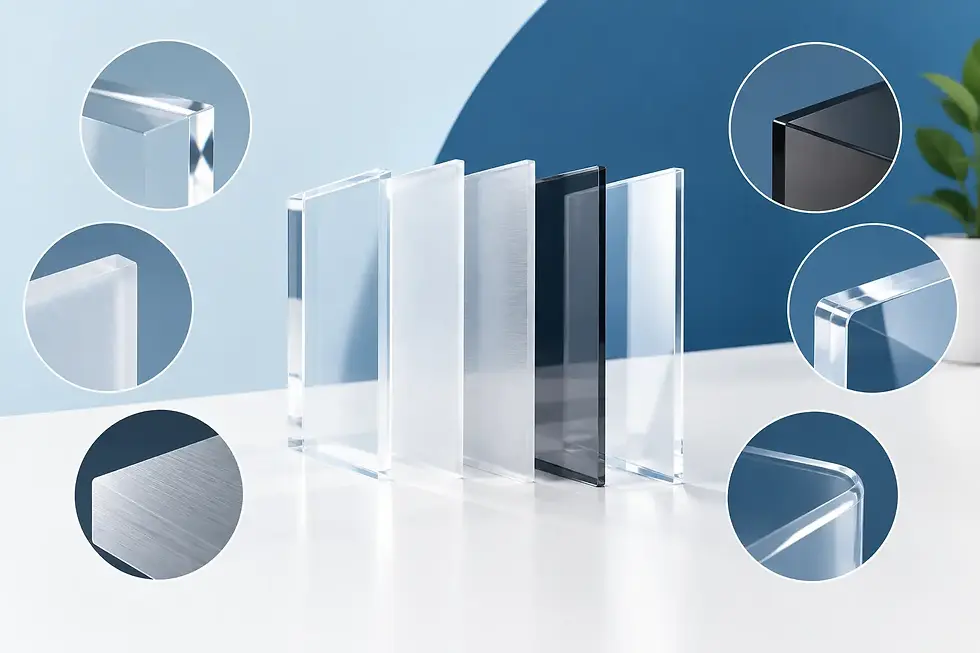
A routed edge does not automatically need to be the final edge. Its finish depends on the acrylic type, cutter selection, feed rate, cutting direction and the visual standard required for the project. CNC routing gives fabricators a controlled starting point for edges that may be left as-machined, polished, sanded, flame treated or incorporated into a bonded assembly.
For opaque panels, functional covers and concealed components, a clean machined edge may be entirely suitable. For clear retail displays, premium plinths or customer-facing panels, additional finishing may be necessary to achieve the desired optical clarity and tactile quality. Specifying the finish early avoids an avoidable mismatch between a rendered concept and the manufactured result.
CNC machining also supports features that improve downstream fabrication. Rebates can locate panels for bonding, engraved fold lines can assist controlled forming where appropriate, and accurately positioned holes simplify the installation of hardware. The best outcome comes from considering cutting, fabrication and finishing as one process rather than separate tasks.
Faster movement from approved file to production
Once a design is resolved and converted into a production-ready file, CNC routing can make manufacturing more efficient, particularly for repeat work. Toolpaths are programmed, materials are nested to make effective use of sheet stock, and production can proceed with a consistent process.
This is valuable for staged fit-outs and multi-site programs, where components may be required in batches over time. Retaining the production information supports repeat orders and makes it easier to maintain dimensions and layout from one run to the next. It also provides a more disciplined pathway for replacement parts when a site refresh or repair is needed.
Efficiency should not be confused with rushing. Every job still requires material checks, machine setup, quality inspection and careful handling. Acrylic surfaces can scratch if protection is removed too early or parts are stacked without care. A controlled process protects both the dimensional result and the presentation of the finished work.
Design flexibility with practical engineering behind it
CNC routing is often associated with flat shapes, but it can play a central role in more sophisticated fabricated pieces. Routed panels can be folded, welded, thermoformed, mechanically fixed or combined with other materials to create enclosures, displays, signage systems and architectural elements.
For this reason, design support at the early stage is valuable. A drawing may be visually correct but still need refinement for cutter access, internal corner radii, fastening, material thickness or assembly order. Identifying these considerations before machining helps preserve the original concept while avoiding unnecessary fabrication complexity.
A common example is the inside corner of a cut-out. Because a rotating cutter is round, it cannot create a perfectly sharp internal corner without a relief feature or an alternative process. Similarly, a component designed to slot into another part needs allowances that account for acrylic thickness variation and the required assembly method. These details are small, but they determine whether parts fit cleanly and reliably.
A strong option for prototypes and production runs
CNC routing suits both ends of the manufacturing scale. For prototypes, it provides a practical way to test proportions, fit, mounting methods and customer interaction before committing to a larger run. A physical sample often reveals issues that are not obvious in a digital model, particularly where lighting, reflections, access or installation are involved.
For production, the same controlled geometry can be carried forward once the design is approved. This continuity reduces the risk of a prototype being made one way and the final run another. It also gives clients confidence that an agreed sample can become a repeatable manufacturing standard.
The economics depend on quantity and complexity. Programming and setup are worthwhile investments for detailed work and repeat production, while a simple single panel may be better suited to another cutting method. Laser cutting, for example, can be preferable for certain fine profiles and material thicknesses. The right choice comes from balancing finish, tolerance, design detail, volume and budget.
Choosing CNC routing as part of the right process
CNC routing performs best when it is selected for a clear purpose: accurate profiles, functional features, repeatable parts or controlled preparation for fabrication. It is not a substitute for thoughtful design, nor does it remove the need for quality checks. It gives a skilled fabrication team the means to execute approved details consistently.
At Platinum Manufacturing, CNC cutting is considered alongside laser cutting, acrylic forming, welding and finishing so the process supports the finished application, not just the first cut. That matters when a component must look refined, install cleanly and perform reliably in a commercial environment.
For your next acrylic project, bring the intended use, drawings, quantities and finish expectations into the conversation early. The strongest result is usually achieved before the router starts, when design intent and manufacturing reality are aligned with precision.


Comments