
Can Acrylic Replace Glass Displays? A Practical View

A retail showcase arrives on site with a chipped corner, a heavy glass shelf requires extra support, or a branded counter display needs an unusual folded form. These are the moments when project teams ask: can acrylic replace glass displays? In many commercial applications, yes. But acrylic is not a universal substitute. The right choice depends on how the display will be used, how it must look, the expected handling, and the level of fabrication control required.
For display projects, material selection should begin with performance rather than assumption. Glass carries a familiar premium feel and excellent scratch resistance. Acrylic offers lower weight, high impact resistance and far greater freedom to cut, form, fold, print and fabricate. A well-specified acrylic display can deliver a refined, high-clarity result while reducing installation complexity and safety risks.
Can Acrylic Replace Glass Displays in Commercial Settings?
Acrylic can replace glass successfully in point-of-sale displays, retail plinths, product risers, protective screens, display cases, museum-style covers, illuminated signage and branded fixtures. It is particularly effective where a display needs custom geometry, frequent relocation, integrated graphics or a low overall weight.
The material is considerably lighter than glass of a comparable thickness. That matters when displays are wall-mounted, suspended, installed in joinery, transported between locations or repositioned during visual merchandising. Lower weight can simplify handling and reduce demands on supporting structures, although fixing design must still be engineered for the finished assembly.
Impact resistance is another clear advantage. Acrylic is less likely to shatter than standard glass, making it a practical option in busy retail areas, public environments and applications exposed to regular handling. If damaged, acrylic generally cracks rather than breaking into loose sharp fragments. This does not eliminate the need for considered design, but it can improve the safety profile of a display.
Acrylic also gives designers more control over the final form. Precision laser cutting and CNC machining can produce accurate profiles, slots, rebates, lettering and component interfaces. Fabricators can heat-bend acrylic into crisp angles, thermoform it into shaped covers, weld components into cases and polish edges for a clean finished appearance. Those processes make acrylic especially useful when a standard flat glass panel cannot achieve the design intent.
Where Glass Still Has the Advantage
Glass remains the stronger choice when surface hardness and long-term resistance to abrasion are critical. In a high-contact environment, such as a countertop display where products are constantly slid across the surface, acrylic can show fine scratches over time. Cleaning practices, dust, jewellery, keys and repeated handling all affect its appearance.
Glass may also be preferred where the project calls for a particular visual character. Low-iron glass can offer exceptional clarity, while tinted, frosted or textured glass brings a weight and permanence that suit certain architectural interiors, premium liquor displays and heritage-sensitive fit-outs. Acrylic can look highly refined, but it should not be specified on the assumption that it will replicate every type of glass exactly.
Heat exposure needs careful assessment as well. Acrylic is not suited to locations near high-output heat sources or where sustained elevated temperatures are expected. It can soften, distort or develop stress-related issues if the design does not allow for its thermal characteristics. For illuminated displays, the heat generated by lighting, ventilation within an enclosure and distance from the source should be reviewed before production.
Chemical exposure is another decision point. Some cleaners, solvents and adhesives can damage acrylic, causing crazing, cloudiness or surface stress. A display intended for a hospitality venue, laboratory-adjacent space or cleaning-intensive environment needs a material and maintenance specification that reflects those conditions.
Clarity Is Not the Same as Durability
Clear acrylic is often selected because it creates an almost invisible support or enclosure. Quality cast acrylic can provide excellent optical clarity, and polished edges can give display components a sharp, premium finish. However, clarity is influenced by more than the sheet itself.
Cutting method, machining quality, edge finishing, bonding technique and protective-film handling all affect the final result. A poorly finished acrylic edge may appear cloudy or show machining marks. Inconsistent adhesive application can create visible bubbles or lines in a display case. For commercial work, these details are not cosmetic extras. They determine whether the finished display reads as precise and intentional or improvised.
Thickness also affects appearance. A heavier acrylic panel can create visual depth and a substantial presence, but it may show more edge colour and can require different joining methods. Thin material may suit lightweight product risers and shelf talkers, while thicker sheet is better suited to plinths, structural display elements and polished-edge features. The correct thickness should be determined by span, loading, fixing points and desired finish, not simply by what is readily available.
Design for Acrylic, Rather Than Copying Glass
The strongest acrylic displays are designed around the material’s properties. Replacing a glass panel with acrylic at the same thickness, with the same unsupported span and identical fittings, is not always appropriate. Acrylic has different stiffness, expansion behaviour and fixing requirements.
Long panels can deflect if they are underspecified. Large sheets can expand and contract with temperature changes. Tight mechanical fixings without adequate clearance can create stress around drilled holes. Sharp internal corners may concentrate stress, particularly where a component is loaded or repeatedly flexed. These issues are avoidable when they are addressed during design development rather than on the workshop floor.
A practical acrylic design uses suitable material thickness, considered support spacing and appropriately sized holes or slots for fixings. It allows for movement where required and avoids exposing stressed edges to unnecessary impact. If an assembly requires bonded joints, the joint design should be planned to suit the loading direction and the required visual finish.
For branded displays, acrylic also creates opportunities that glass does not readily offer. It can be routed to accept printed panels, engraved for edge lighting, layered to create dimensional graphics, formed around products or combined with aluminium, timber and other substrates. This lets designers turn a protective or functional component into a visible part of the brand experience.
Choosing the Right Acrylic Grade and Finish
Not all acrylic is the same, and grade selection has a direct effect on fabrication quality and service life. Cast acrylic is often preferred for premium displays because it machines, polishes and thermoforms well. Extruded acrylic can be suitable for some applications, but its behaviour in machining, bonding and heat forming differs.
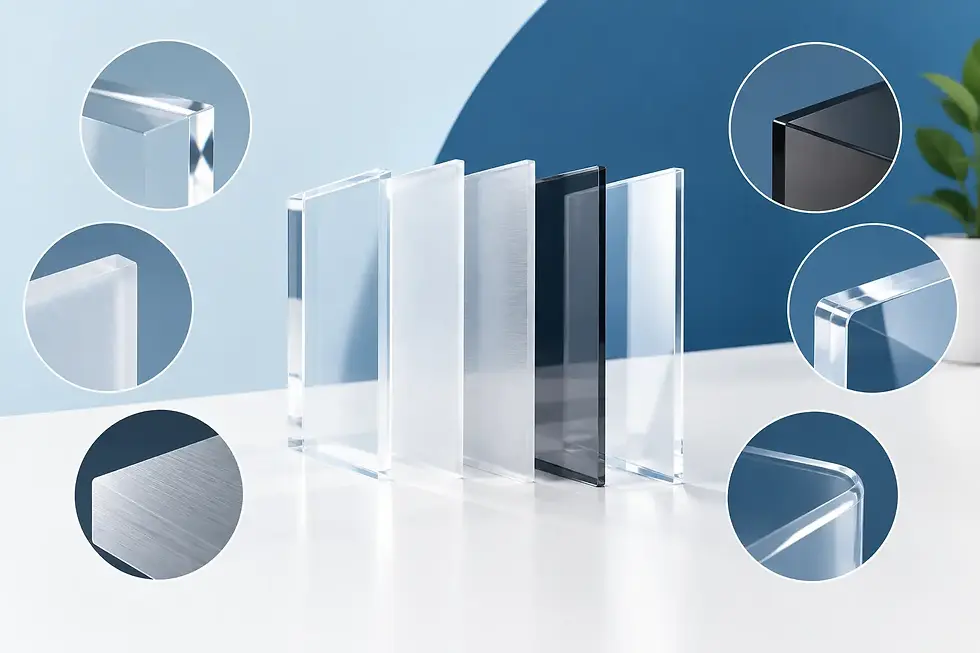
Finish selection should reflect both the intended environment and the display’s purpose. Clear acrylic supports product visibility. Opal and diffused grades suit illuminated features. Tinted, frosted and coloured sheets can provide privacy, contrast or stronger brand alignment. Matte surfaces can reduce glare and fingerprints, while gloss finishes may better suit a high-polish retail environment.
Scratch-resistant coatings are available for applications where handling is expected, but they should be assessed alongside fabrication requirements. Coated materials may need particular cutting, forming or bonding processes. The best outcome comes from confirming the finished-use conditions before material is ordered, not after samples have been approved on appearance alone.
Fabrication Quality Determines the Result
Acrylic display work is often judged at close range. Customers see edge quality, alignment, joint consistency and surface condition before they notice the overall structure. That makes disciplined fabrication essential.
A production-ready process begins with accurate drawings or prototypes. This is the point to confirm dimensions, product clearances, load requirements, assembly sequence, transport constraints and fixing details. A prototype can reveal whether a shelf flexes, a folded return interferes with stock, or an illuminated edge creates unwanted hotspots. It is generally far more efficient to resolve those issues before a larger run begins.
Precision cutting should be matched to the part geometry and finish requirement. Laser cutting can produce clean, detailed profiles in suitable materials, while CNC machining is valuable for pockets, drilled features, complex assemblies and controlled tolerances. Folding, thermoforming and welding then need to be managed with equal care to maintain consistent angles, clean joins and repeatable results across multiple units.
Protection through packing, transport and installation matters too. Acrylic surfaces can be marked before a display reaches its final location if protective film is removed too early or components are stacked without separation. A quality display is the result of control from material handling through to delivery.
The Better Question for Your Project
Rather than asking whether acrylic is better than glass, ask what the display must withstand and what it must communicate. If weight, impact resistance, custom fabrication and design flexibility are priorities, acrylic can be the better material. If maximum scratch resistance, high heat tolerance or a specific glass aesthetic is non-negotiable, glass may remain the right choice.
Many projects benefit from using both materials strategically. Glass might be retained for a high-wear shelf surface, while acrylic forms the enclosure, branded risers, lighting elements or shaped feature panels. The decision does not need to be all or nothing.
For commercial displays, the most reliable outcome comes from involving the fabricator early. Platinum Manufacturing works from design intent through prototyping and production to ensure the selected acrylic grade, thickness, fabrication method and finish are appropriate for the job. Precision is most valuable when it is built into the decision before the first component is cut.


Comments